
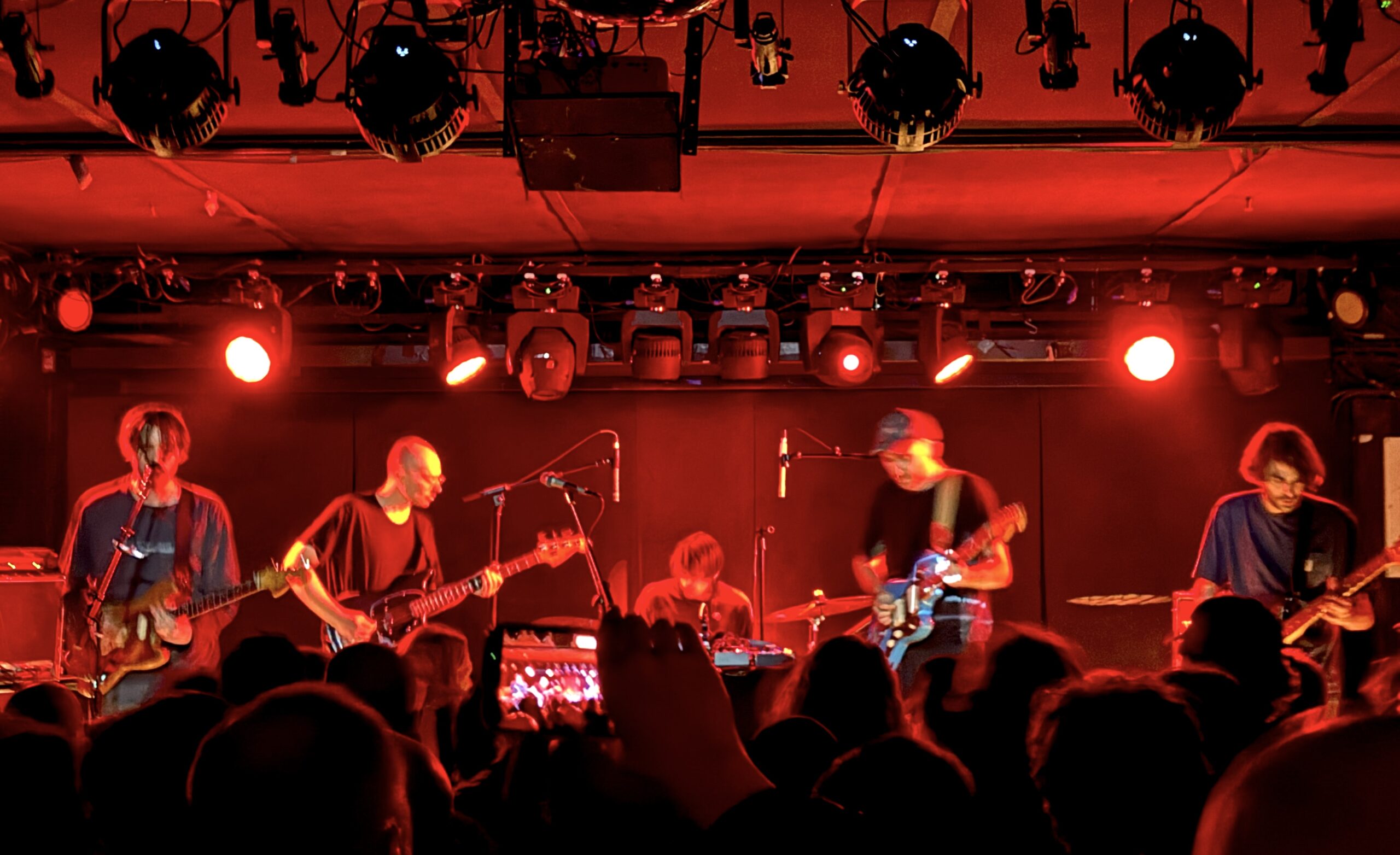
Mercury Lounge was packed, completely sold out. I don’t know the venue’s maximum capacity, but there wasn’t room for one more person. On a night that felt like a break from the recent bad weather, Ulrika Spacek brought their hypnotic blend of shoegaze, loops, post punk, and indie rock to New York, performing tracks from their latest album, EXPO, in a set driven by obsessive energy and dense, shifting textures, leaning into the glitch between analogue and electronic.
We spoke with Rhys Edwards about the surreal moments of touring, their early days in Dalston, and how people here make every show feel special.
★ What do you like most about New York when you’re here?
Ulrika Spacek: Well, first of all, New York is New York, so it always feels exciting—kind of the center of the world to us. But in many ways, it’s its likeness to London—it feels like we understand it. We often end our US tours in New York before flying home, so after weeks of driving through the American wilderness and desert, it feels like a city unto itself, but one that connects to Europe and the rest of the world.
★ What’s something about touring the U.S. that still surprises you?
Ulrika Spacek: Well, this might sound a bit geeky, but we’re convinced that because of the difference in voltage (110 vs. 230 volts), guitars through amps sound better in the U.S. Everyone’s guitar sounds are good haha. It’s also amazing for us to be so far home and have such a supportive audience here, trying not to generalize or stereotype but American fans are very warm, friendly and positive. They are also prepared to really travel for shows, it’s been very common to speak to fans who have perhaps driven 4/5 hours to come and see us. It just makes each gig really meaningful to us, as we know that for much of the audience, watching us play is a special night for them.
★ Has Ulrika Spacek ever had a moment that felt too surreal to be real?
Ulrika Spacek: We had a member of the band quit halfway through a tour while we were driving to a show in Denmark. It went from surreal to very real quite quickly, though. We got through the show and figured the rest of the tour out luckily.
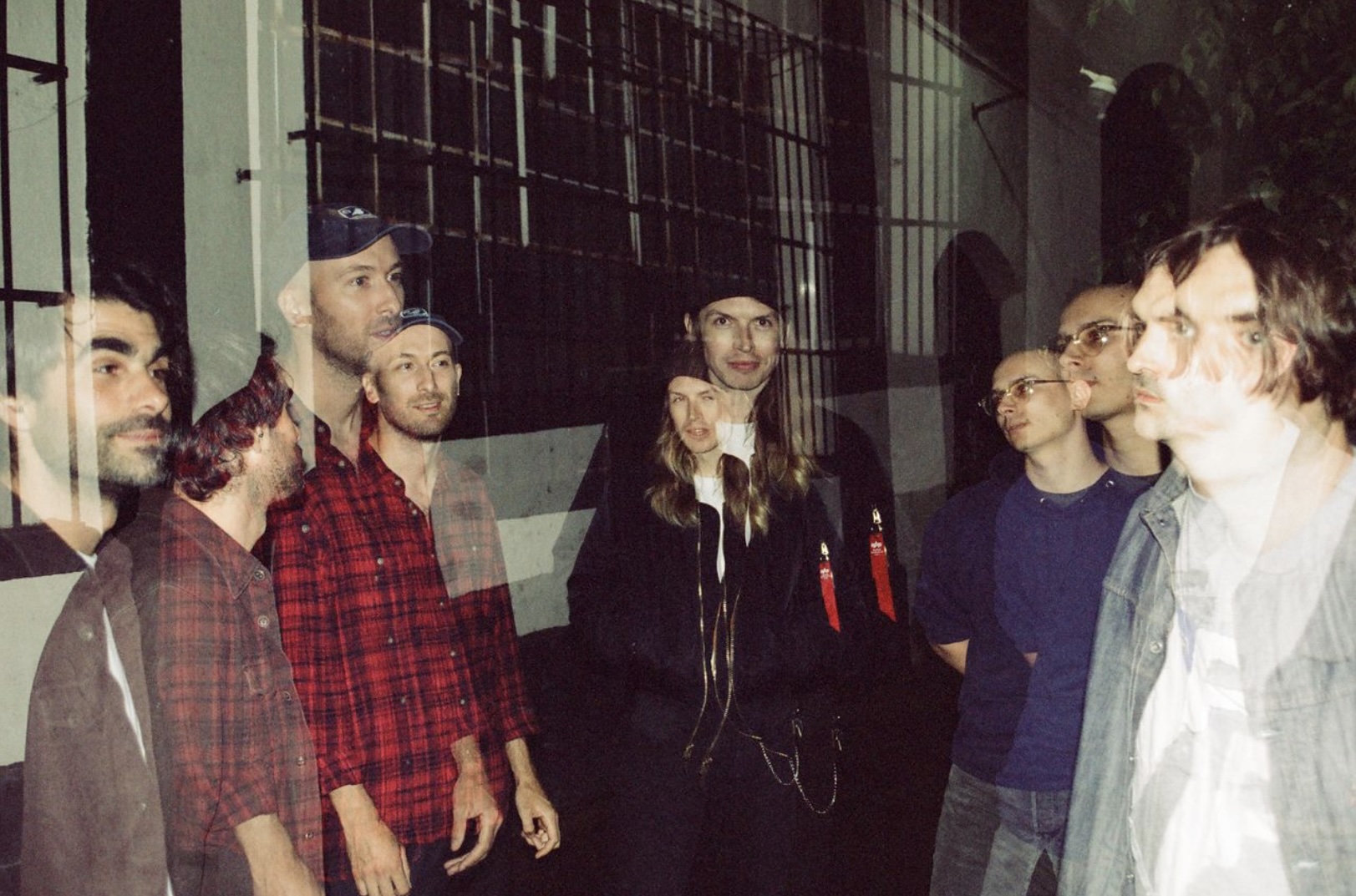
★ When you think of Dalston around 2015, almost ten years ago, what memories come to mind?
Ulrika Spacek: A vibrant place, perhaps similar to when people started moving to Bushwick. There were a lot of gigs and parties, with an abundance of places to do things. We started our own night around then choosing a pub that wasn’t doing much at the time, just remember it as quite a collective time. If you put something new on people were curious and generally came out to support it. Of course, it’s gotten harder. London, like New York, is very transient, so areas where people create things change as they get priced out of the neighborhoods they’ve culturally contributed to.
★ There’s a lot of nostalgia for the ’90s right now. Do you think we’re stuck in an excessive nostalgia for that era, or is it just a passing trend?
Ulrika Spacek: It feels like there’s always been an obsession with nostalgia in cultural life as we’ve grown up, perhaps driven by the internet. But the internet is so vast that every era has its own corner of nostalgia. For instance it feels like there’s much more of a Y2K nostalgia going on atm. I think anything that’s too “on the nose” just isn’t interesting to us. We’ve always been drawn to a more patchwork expression of nostalgia. I think it’s easy to sometimes say everyone is backwards looking, but if you look in between the cracks there’s a lot of artists being quite innovative patching together different influences from different times. It’s just a bit harder to digest on the surface, so less people connect with it and it’s less popular. It’s easier to understand something you have seen before, but time helps, there’s plenty of artists that get more recognition a little later down the line.
★ Three words that define your sound?
Transient, Contrast, Detail.
★ The Brian Jonestown Massacre is said to be guided by the spirit of Brian Jones. Would you say Ulrika is guided by the spirit of Laurent Koscielny?
Ulrika Spacek: Rather than guided, I’d probably say haunted—or cursed—by it, haha. When we were making our album ‘Compact Trauma’ we started the writing and recording process with a lot of momentum, there’s a few of us who are Arsenal fans and at some point a sticker of Laurent Koscielny ended up on the album lyric/idea book. He was having a great season, on his way to play for France in the world cup and then he suffered a bad achilles injury. It just so happened that around this time, our album was also stalling in terms of progress, with the wheels, in many ways, coming off for a while. So Staring back at that sticker became some sort of a metaphor with that achilles injury. Come to think of it now, the depth of the title ‘Compact Trauma’ just got a little deeper for us. ◼️
Ulrika Spacek
Rhys Edwards – Vocals, Guitar, Piano, Keyboards, Sampler, Electronics
Joseph Stone – Keyboards, Piano, Guitar, Sampler, Saxophone, Electronics
Callum Brown – Drums, Percussion, Electronics
Syd Kemp – Bass, Electronics
Rhys Jenkins – Guitar
Check out EXPO
Visit Ulrika Spacek on Instagram